Here’s the thing—most people think living higher up automatically means cleaner air, right? Makes sense on the surface. But the reality is way more complicated, and honestly, pretty interesting. The answer changes depending on where you live, what season it is, and a bunch of other factors we’re about to break down.
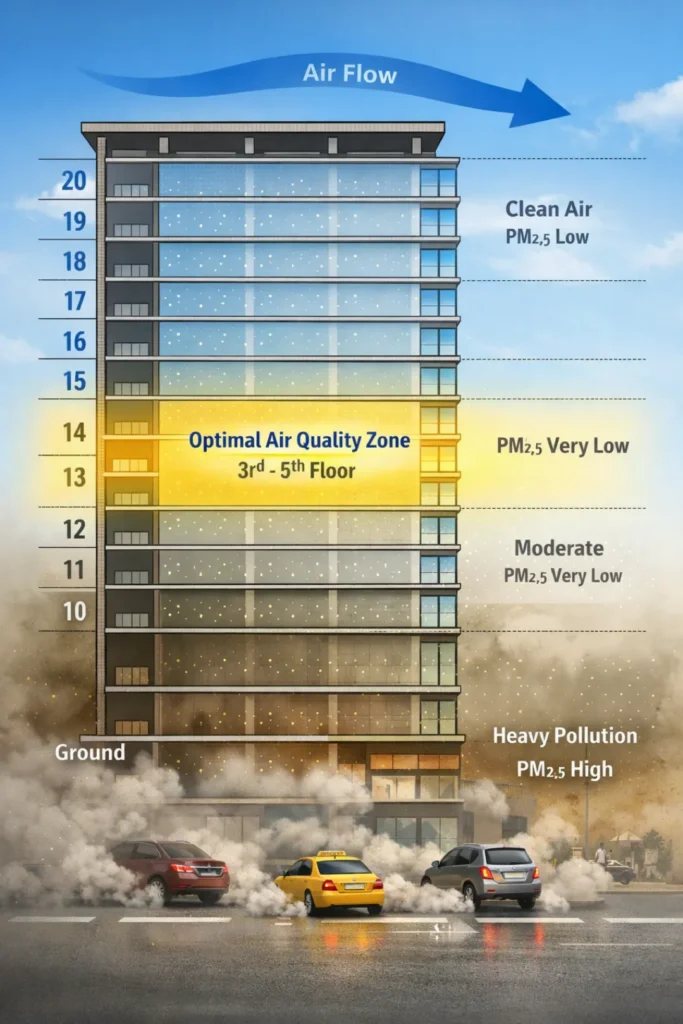
Let me give you the straight story: In most urban areas, the 3rd to 5th floor is actually where you get the purest air. That’s roughly 10-15 meters up—the sweet spot where you escape ground-level traffic pollution but haven’t climbed high enough to hit different air mixing layers.
Why Ground Level Is Actually the Worst Spot
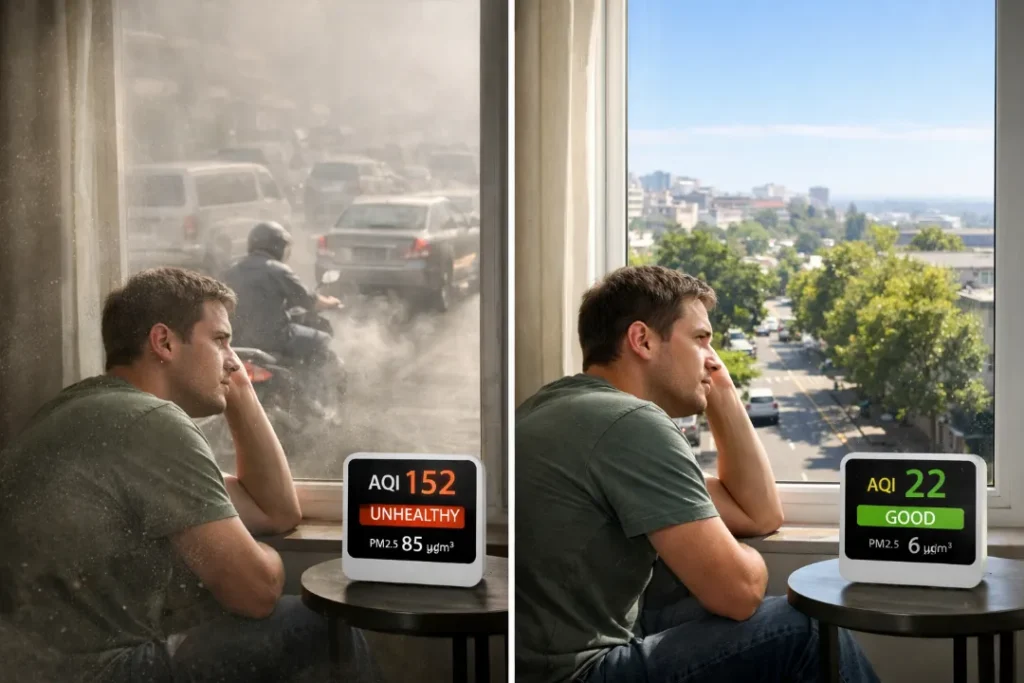
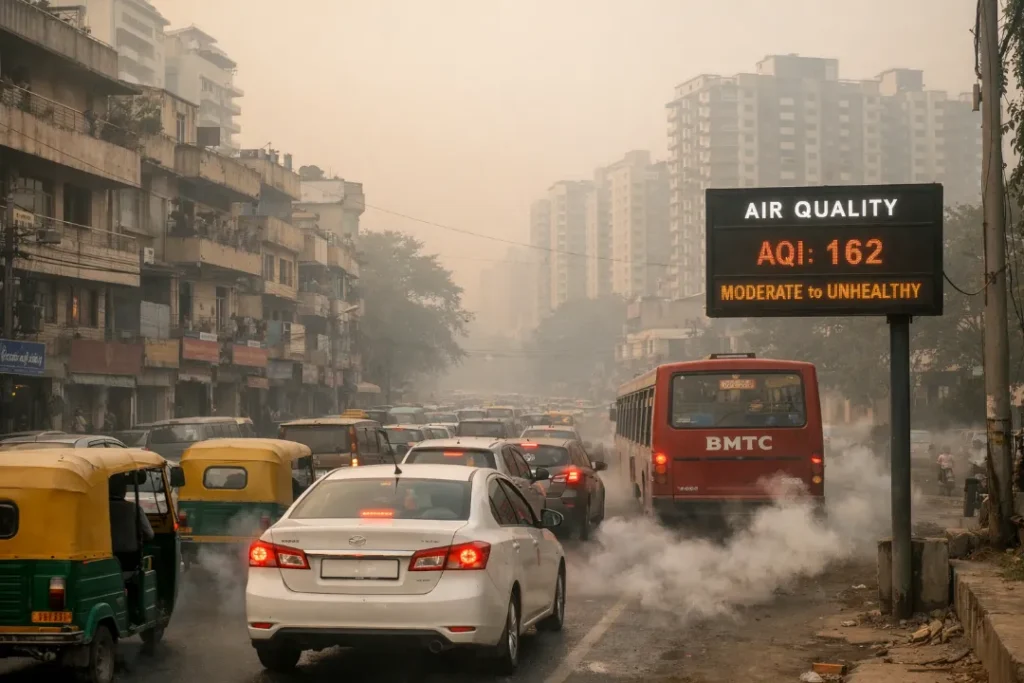
If you’re living on the ground floor or first two floors near a busy road? Yeah, you’re getting hammered with pollution. Here’s what’s happening: vehicles pump out nitrogen dioxide, particulate matter (PM2.5 and PM10), and carbon monoxide right at ground level. It’s like sitting in a perpetual exhaust plume.
Research from Columbia University studied this in detail. They measured pollution levels from the ground floor all the way up to the 32nd floor in New York City. The findings were pretty clear—higher floors had substantially lower concentrations of black carbon and certain pollutants compared to ground-level apartments.
The key insight? When you’re on the first or second floor near traffic, you’re basically at the mercy of every emission. The air doesn’t mix well down there, especially during rush hours or when weather conditions trap pollution. You’re literally breathing directly what’s being pushed out of exhausts.
The 3-5 Floor Sweet Spot: Here’s Why It Works
This is where pollution drops significantly—sometimes by as much as 40% for certain pollutants. Why? A few reasons working together:
You’re above the worst of the ground-level traffic emissions. At this height, pollutants have started to disperse upward rather than concentrate in a tight band. But you haven’t gone so high that you’re dealing with completely different atmospheric conditions.
The air still mixes reasonably well at this elevation, so pollution doesn’t stagnate like it does closer to the ground. Think of it like the Goldilocks zone—not too low, not too high.
Even during winter months when weather traps pollution (called thermal inversion), the 3-5 floor range stays relatively better protected than ground level. Studies show that during non-heating seasons, pollution on the 6th-32nd floor was 1.5-2 times lower than lower floors, but the 3-5 range offers the best practical balance.
What About Really High Floors? The Mixed Bag
So should you aim for the 16th floor and above? Not necessarily, despite what some people think.
Here’s what health experts and research actually shows: Above 16 floors, you’re entering a different game. According to India TV News, living above the 16th floor doesn’t guarantee cleaner air because long-range pollutants like PM2.5 can travel on wind currents and settle at any height.
Ground-level ozone rises with wind patterns and settles at higher altitudes depending on weather. Volatile organic compounds from cars and buildings settle all over the place. During thermal inversion events (when cold air gets trapped below warm air), you might be sitting in a pollution layer even at the 20th floor.
The other thing? Very high floors have lower oxygen levels and slightly reduced air pressure. For most healthy people, this is negligible—like less than 2% difference per 100 meters. But if you have respiratory issues or heart problems, it can matter.
Parks Help, But They’re Not a Magic Solution
Having a 10-acre park in front of your building? That’s genuinely good. According to Frontiers in Ecology and Evolution, urban parks can lower PM2.5 levels by up to 30% depending on wind patterns and vegetation. The trees act as pollution sinks, actually removing particles from the air.
But here’s the catch: this benefit is strongest within 100 meters of the park. And it doesn’t reverse the vertical gradient issue. You’re still better off on a higher floor than ground level, even with a nice park outside.
Building Type Matters More Than You Think
Low-rise vs. high-rise buildings? Huge difference. People in low-rise buildings are exposed to higher pollution levels because they’re typically built right along streets next to roads, shops, and traffic. High-rise buildings are usually set back from main roads, isolated from commercial spaces, and sometimes surrounded by green space that helps with dispersion.
The Columbia study found that at the same floor level, residents in high-rise buildings got 10-30% less pollutants than those in low-rise buildings. The building itself and its location matter as much as which floor you choose.
Where to Avoid (And Where to Go)
Cities with the cleanest air globally:
If you’re considering moving internationally, Zürich, Switzerland tops the list at just 0.7 µg/m³ PM2.5 average. Perth, Australia comes in second at 1.4 µg/m³. Most North American cities like Vancouver and Portland offer decent options in the 3-5 µg/m³ range.
In Bangalore specifically:
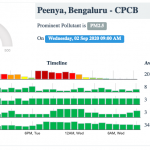
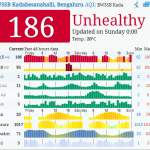
Bangalore is currently sitting at around 34-86 µg/m³ PM2.5 depending on the day—well above the WHO guideline of 15 µg/m³. According to AQI.in, it ranges from “acceptable” to “unhealthy” throughout the day. Morning hours (around 7-10 AM) are consistently worse due to traffic and thermal inversions. If you must live in Bangalore, targeting floors 3-5 in high-rise buildings set back from main roads is genuinely your best move.
The Seasonal Factor You’re Missing
Here’s something most people don’t think about: winter is way worse for ground-level pollution. During heating season and winter months when air gets trapped close to the surface, being on the ground floor becomes even more problematic. The gap between ground level and higher floors widens during cold seasons.
This is why the Columbia study specifically noted that seasonal variations matter. Non-heating seasons showed sharper differences between ground and higher floors. In heating season, pollution is more evenly distributed vertically because air is being pushed up from heating systems and exhaust, which somewhat masks the gradient.
Building Ventilation Systems: The Often-Overlooked Factor
Here’s something that genuinely matters but gets ignored: your building’s ventilation system. Central AC in high-rises sounds great, but older systems don’t filter PM2.5 effectively. Modern buildings with advanced filtration? They can actually help counteract being at any specific floor.
Dr. Vikas Mittal from CK Birla Hospital in Delhi points out that proper ventilation systems in high-rises enhance indoor air quality by circulating and filtering air. So an old building on the 5th floor might be worse than a modern building on the 8th floor.
Wind Direction and Local Geography
Can’t ignore this: wind patterns and local geography completely change things. If your building faces a major highway and the prevailing wind blows directly toward you, being higher up helps less. If there’s a valley or terrain feature that traps pollution in specific zones, you might be stuck in that zone regardless of floor.
Cities like Delhi with the Aravalli Range nearby deal with uneven pollution dispersion. Mumbai’s coastal areas have different patterns. This is why hyper-local knowledge matters—ask locals and look at local monitoring data, not just general rules.
Key Takeaways
Best floors overall: 3rd to 5th floor (10-15 meters) in most urban residential areas
Ground floor pollution: 40-50% higher than optimal floors; avoid if possible
Above 16th floor: Not inherently safer despite popular belief; long-range pollutants reach all heights
Building type: High-rise > Low-rise; set-back from roads > street-level
Parks and green space: Helpful but only within 100m radius; real benefit is 10-30% reduction
Seasonal impact: Winter worse for ground level; differences more pronounced non-heating season
Ventilation systems: Modern buildings with advanced filtration can offset floor disadvantage
Wind and geography: Local factors override general rules; check neighborhood specifics
Cities to consider: Zürich, Perth, Vancouver offer genuinely clean air; Bangalore requires strategic floor selection
Practical Action Steps
Check your local AQI data before signing any lease or purchase. Look at time-of-day variations—morning rush hours are consistently worse.
If choosing between apartments, prioritize 3rd-5th floor in high-rise buildings set back from main roads over any floor in low-rise buildings.
Invest in a good air purifier regardless of floor. It’s not either-or; it’s both. Even at optimal floors, supporting air quality indoors matters.
Ask about building ventilation systems when touring apartments. Modern MERV-13 or better filters make a tangible difference.
Talk to neighbors about their respiratory health experiences. Real-world data from people living there beats theory.
If you have respiratory conditions, consider the health trade-offs. Higher floors mean slightly lower oxygen, but that’s negligible for most people and often outweighed by pollution reduction.
Watch thermal inversion forecasts in your area. Apps like BreezoMeter or local environmental agencies warn when pollution will be trapped. On those days, run air purifiers more intensively.
The bottom line? You can’t escape air pollution entirely in most cities, but you can absolutely make smarter choices about where and how high you live. The 3-5 floor sweet spot exists because it solves real physics—it gets you above ground-level sources but keeps you where air still mixes reasonably well. That’s not perfect, but it’s considerably better than most people are currently breathing.