By Zahid H Javali
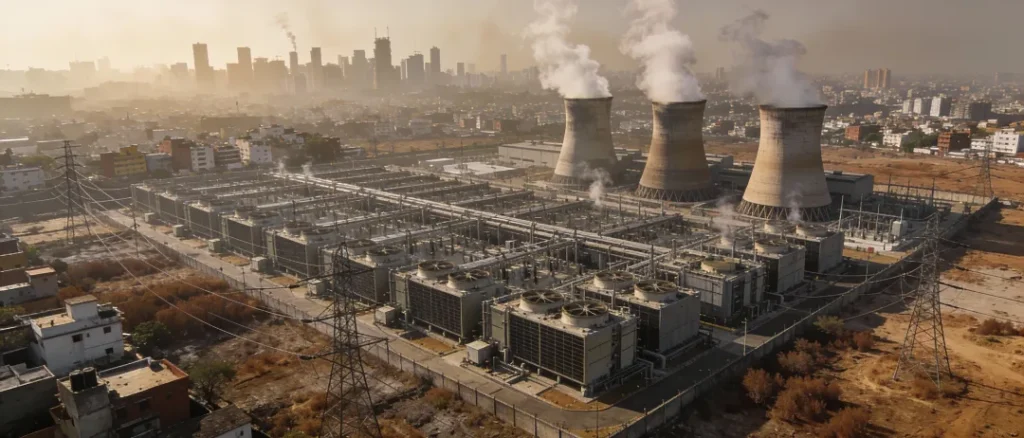
Picture this: every time you search Google, stream a Netflix show, or prompt ChatGPT to write an email, servers somewhere on Earth are burning through electricity to process your request and then desperately cooling themselves down to avoid melting. You know what? I think we don’t really talk enough about how insanely power-hungry this infrastructure is—especially as billions of people in countries like India suddenly come online and demand all these digital services simultaneously. Here’s the thing: data centers are grappling with an existential problem. They’re generating so much heat that traditional cooling methods are breaking down, consuming staggering amounts of water and electricity in regions that are already running dry. And India’s about to become ground zero for this crisis.
The Global Heat Explosion: Why Air Cooling Isn’t Cutting It Anymore
Let me break down what’s happening. A typical data center consumes about 40% of its total electricity just keeping cool. Think about that for a second—nearly half your power bill is just fighting heat. But here’s where it gets wild: AI workloads have completely changed the game.
Traditional servers? They could sit comfortably with modest cooling. AI training clusters? Those GPUs are like putting a thousand hair dryers in a closet and wondering why it’s melting. According to McKinsey research, by 2030, around 70 percent of all new data centre capacity will cater to AI-heavy workloads, and these aren’t your grandmother’s servers. They require 3 to 5 times more computational power and 2 to 3 times more cooling.
The problem is so severe that the World Economic Forum estimates extreme heat, drought and other climate hazards could drive annual costs up at data centres globally by $81 billion by 2035, rising to $168 billion by 2065. That $3.3 trillion in cumulative losses by 2055 isn’t some abstract number—it’s money that gets passed on to every business, every government, and ultimately, every person relying on digital services.
Air Cooling’s Dirty Secret: Why Water Consumption Is Out of Control
Here’s where traditional air cooling reveals its weakness: it doesn’t work well in hot climates, and it absolutely breaks down at the density levels modern data centers need. So operators switched to water-based cooling, thinking they’d solved the problem. Spoiler alert: they created a different crisis.
An average 100-megawatt data centre consumes about 2 million litres of water every single day. To put that in perspective, that’s the daily water consumption of roughly 6,500 US households. In the US, data centers are already among the top 10 water-consuming commercial sectors.
But India? India has made things infinitely more complicated by building data centers precisely where water is scarcest.
India’s Perfect Storm: Too Many Data Centers, Too Little Water
I need to be real with you here: India’s data center growth trajectory is insane. The country currently consumes 13 terawatt-hours (TWh) of electricity for data centers—that’s 0.84% of national consumption. By 2030, that’s projected to surge to 57 TWh, representing 2.6% of India’s total electricity demand. Nearly a 5x increase in five years.
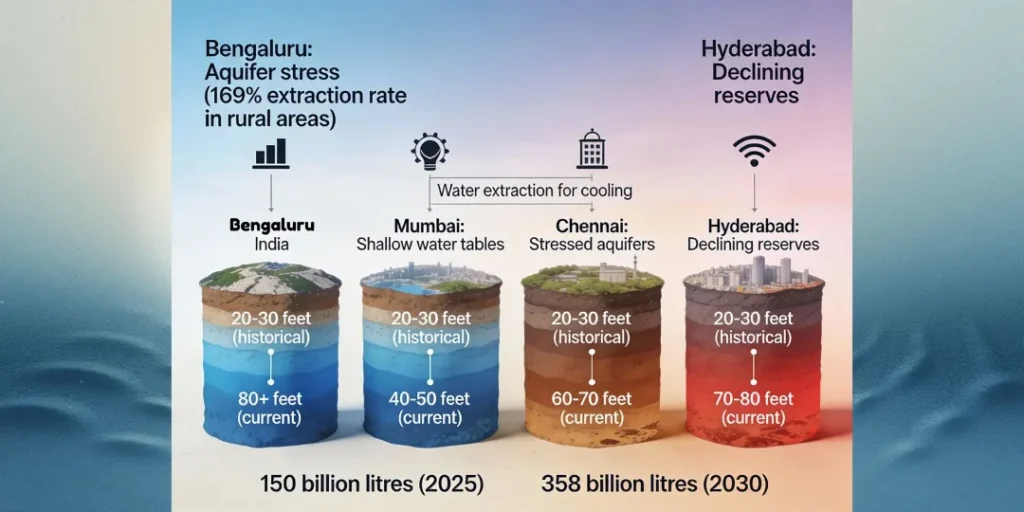
And it’s going to get worse because data centre water consumption is expected to more than double from 150 billion litres in 2025 to 358 billion litres by 2030.
The issue? Most of India’s 1,300+ megawatts of data center capacity is concentrated in metros like Mumbai, which hosts over half of all facilities, plus 15-18% in Chennai due to proximity to submarine cable connectivity. These cities are already bleeding water. Mumbai delivers just over 3,000 million litres daily against much higher demand. Chennai? Daily supply is around 1,000 million litres when demand is far higher.
Take Bengaluru, that Silicon Valley of India everyone celebrates. The Bengaluru Rural district is extracting groundwater at 169 percent of permissible limits—69 points above what’s sustainable—with no net groundwater available for future use. The entire district has been officially classified as “over-exploited” since 2013. And this is where data centers keep expanding.
The Math That Keeps You Awake at Night
Let’s get specific. Researchers estimate that a small 1 MW data centre consumes about 26 million litres of water annually. Sounds manageable until you extrapolate: a 30 MW facility uses roughly 780 million litres yearly—that’s 219,700 litres every single day, equivalent to the domestic water needs of approximately 15,830 people in urban India.
One of the mega-facilities being built—Yotta Data Centre Park in Greater Noida—plans to eventually reach 160 MW across six data centers. That would translate to usage of around 4.2 billion litres annually, comparable to the annual water use of a town of about 85,000 people.
When you zoom out to the sector level, researchers estimate that a 100 MW facility is capable of consuming around 2.5 billion litres of water annually. With India planning hyperscale campuses reaching 5 gigawatts of capacity, you’re looking at catastrophic water stress scenarios.
Why Global Tech Giants Are Betting Billions on India (And the Water Problem)
Here’s the paradox that keeps regulators up at night: Amazon just announced a $35 billion investment in India by 2030, focused on AWS infrastructure and AI capabilities. Just a day before, Microsoft pledged $17.5 billion to fortify the nation’s AI ecosystem, including a new “hyperscale cloud region” in Hyderabad set to go live by mid-2026. Google’s investing $15 billion to create a GW-scale AI hub in Visakhapatnam.
That’s over $67 billion in committed capital. These companies aren’t stupid—they know water will be an issue. So here’s what they’re actually doing: they’re building renewable energy infrastructure alongside the data centers. Amazon, Microsoft, and others have set targets to source 100% of their energy from renewable sources by 2025 through 2030. Not exactly altruism—it’s infrastructure necessity masquerading as corporate responsibility.
The Technology Solution: Advanced Cooling Can Cut Heat by 40-50% (Here’s How)
Okay, so we’ve established the problem is massive. But the tech industry isn’t just complaining—they’re investing heavily in solutions. And honestly, some of these technologies are genuinely impressive.
Liquid Cooling Revolution
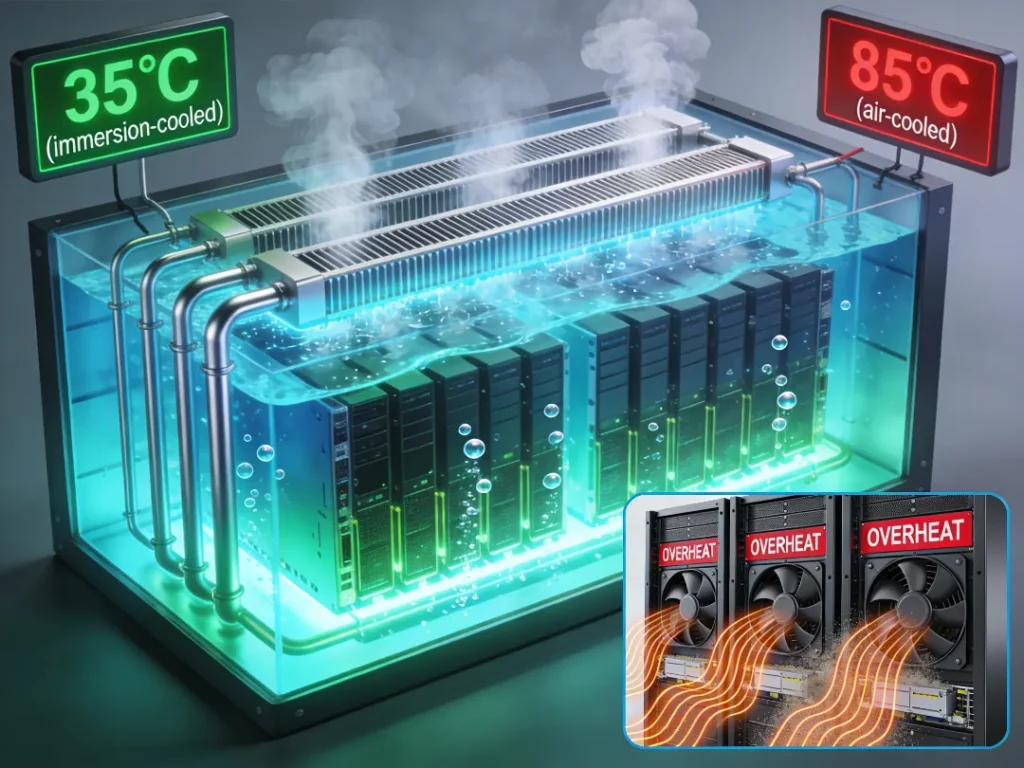
The first major breakthrough is liquid cooling. Air conducts heat poorly, right? Water conducts heat approximately 25 times more efficiently than air. Better yet, sophisticated dielectric fluids used in immersion systems conduct heat approximately 3,500 times better than air.
Modern liquid cooling systems can reduce cooling energy consumption by up to 40% and enable sixfold increases in rack power density. That means in the same physical footprint, you can fit exponentially more computing power while actually using less electricity for cooling. It’s not magic—it’s thermodynamics.
Immersion Cooling’s Water Paradox
Here’s where it gets interesting: data centres that have adopted immersion cooling to some extent save, on average, 15,000 MWh of energy every year compared to those who do not currently use this technology, according to a recent Castrol report. That’s a 30% energy reduction.
But the water savings? They’re even more dramatic. Immersion cooling can save data centres at least 3.5 million litres of water every year, compared with those that rely entirely on air cooling. That’s an 82% reduction in water usage for facilities that implement it, with some studies suggesting water consumption can be reduced by up to 89% compared with air cooling.
Two-Phase Immersion: The Heat-Beating Heavyweight
Now, two-phase immersion cooling is where things get really interesting. Instead of keeping fluid as liquid, servers or IT components are submerged in a dielectric liquid where the fluid undergoes a low-temperature evaporation process to cool hot components. The gas is then cooled again by a heat exchanger to allow return flow.
Why does this matter? Microsoft research found that cold plates and two immersion cooling technologies reduce greenhouse gas emissions 15 to 21 percent over their entire life cycles, energy demand 15 to 20 percent and water consumption 31 to 52 percent in datacenters, compared with air cooling.
That 31-52% water consumption reduction in two-phase immersion? That’s the kind of efficiency gain that actually changes the game.
The 40-50% Heat Reduction Target: Is It Real or Marketing Fluff?
Here’s what the industry is actually aiming for. The European Union’s Energy Efficiency Directive now mandates that data centers over 500 kilowatts must publicly report PUE metrics. PUE—Power Usage Effectiveness—is the ratio of total facility energy to computing energy. An ideal PUE is 1.0 (meaning zero overhead). In reality, leading facilities are targeting PUE values below 1.2, with some hyperscale operations achieving results below 1.1 through advanced cooling systems and renewable energy integration.
For newly planned data centres in Germany (those commencing operation as of 1 July 2026), a maximum annual average PUE value of only 1.2 will apply. For operational data centres (operational before 1 July 2026), a maximum annual average PUE value of 1.5 will apply as of 1 July 2027 and 1.3 as of 1 July 2030.
So yes, the 40-50% reduction targets are real—they’re built into binding EU regulations, and they’re achievable with current technology. Here’s how it breaks down:
| Cooling Technology | Energy Reduction | Water Reduction | Key Benefit |
|---|---|---|---|
| Liquid cooling | 40% | Moderate | Better heat transfer |
| Immersion cooling | 30% | 82-89% | Efficient for water-stressed regions |
| Two-phase immersion | 20-30% | 31-52% | Highest efficiency, passive system |
| AI-driven optimization | 15-25% | Indirect | Real-time adjustment |
India’s Path Forward: The Renewable Energy Gamble
India’s facing a choice: either transform how data centers operate, or risk catastrophic resource depletion. The country knows this, which is why it’s moving aggressively on two fronts.
Renewable Energy Scaling
India is projected to become APAC’s second-largest consumer of electricity for data centres by 2030, with demand rising fivefold to 57 TWh. That’s massive. But here’s the good news: data centres will require an extra 15-30 GW of power, accounting for about 10% of the country’s planned renewable energy additions during this period.
India has significant untapped solar and wind potential, coupled with increasingly competitive battery storage solutions, positioning the nation to handle this surge sustainably. In fact, as of Q2 2025, around 40% of India’s renewable energy pipeline is already under implementation, while an additional 10–12% is in the tendering stage.
State-Level Incentives and Regulatory Push
Different Indian states are getting creative. Karnataka has concessions making data centres eligible for industrial power tariffs instead of commercial power tariffs if 30% of the centres’ energy use is green, and data centres drawing more than 50% of their energy use from renewable sources will be reimbursed the INR 0.50 surcharge per unit for five years.
Tamil Nadu grants incentives where at least 30% of energy needs are fulfilled by renewable power sources, with centres entitled to a 100% subsidy on electricity duties and taxes for five years. Maharashtra has a power tariff subsidy of INR 1 per unit for five years for certain new data centre units.
The TERI-NSEFI Partnership
Here’s something most people don’t know about: the TERI-NSEFI Green Data Center Coalition has been conceived as a dedicated platform to accelerate the decarbonization of data centers by shaping policy and regulatory frameworks, promoting innovative renewable energy instruments such as Virtual Power Purchase Agreements and round-the-clock storage.
The ambition is staggering: greening data centers could potentially reduce their emissions by 88%, with transformative impacts for the country’s overall decarbonization targets.
The Global Liquid Cooling Market: This Isn’t Theoretical Anymore
This technology transition isn’t hypothetical—it’s happening right now. The global data center immersion cooling market size accounted for USD 1.52 billion in 2024 and is predicted to increase from USD 1.81 billion in 2025 to significant growth through the decade. That’s real money, real deployment.
According to IDC analyst Sean Graham, 22% of data centers are using liquid cooling techniques. 90% of data centre experts are thinking about switching to immersion cooling as a primary system between now and 2030.
But here’s the catch: 74% of data centre experts believe that immersion cooling is now the only option for data centres to meet the current compute power demands. It’s not optional anymore—it’s essential for anyone serious about managing heat in AI-era data centers.
The Unresolved Questions: Policy, Transparency, and Local Communities
Here’s where I need to be honest about the gaps. Despite all this technology and investment, India doesn’t have comprehensive regulatory frameworks forcing data center operators to disclose water consumption. Companies and governments reveal little about how much water these energy-hungry facilities actually consume.
Some of the world’s largest data center operators aren’t transparent about sourcing practices. In 2023, Google reported that nearly 80 per cent of the water used for cooling at its global data centres was potable. That means freshwater—the same water local communities need for drinking and cooking.
Local communities are already suffering. In Tusiana, where Yotta is building its facility in Greater Noida, residents report that two decades ago, groundwater was accessible at 20-30 feet. Now, they must dig at least 80 feet. Multiply that story across dozens of locations where data centers are planned, and you have a humanitarian crisis quietly building.
Key Takeaways: What Actually Needs to Happen
Let me crystallize this into actionable insights:
Technology is ready: Immersion cooling, two-phase systems, and AI-driven optimization can reduce heat by 40-50% and water consumption by 80%+. These aren’t future concepts—they’re being deployed now.
Renewable energy is the enabler: India needs 15-30 GW of additional renewable capacity to power data center growth. That’s achievable and cost-competitive with conventional power.
Regulation must tighten: EU-style PUE mandates (1.2 for new facilities) need to be implemented in India, with mandatory water consumption reporting and ESG accountability.
Location matters: Concentrating data centers in water-scarce metros like Mumbai, Bengaluru, and Chennai is unsustainable. Distributed, cooler-climate facilities need incentives.
Hyperscalers must lead: Amazon, Microsoft, Google, and others have committed $67 billion. They need to make waste heat recovery, recycled water systems, and renewable energy integration non-negotiable conditions.
Local communities must have voice: Permits should require community impact assessments and water availability verification before approval. No more building data centers in already over-exploited aquifers.
The Bottom Line
You know what keeps me up at night? It’s not the technology—the solutions are honestly impressive. It’s whether India’s policy and governance can move fast enough. The data center boom is happening right now. By 2030, we’ll know if India managed to decouple digital growth from environmental destruction, or if it became a cautionary tale of infinite ambition meeting finite resources.
The next five years will define whether data centers become architects of sustainability or monuments to humanity’s inability to plan ahead. The cooling technology exists. The renewable energy potential exists. What’s missing is the political will to enforce standards before it’s too late.
The heat crisis is real. The solutions are ready. The question is: will we use them before the taps run dry?