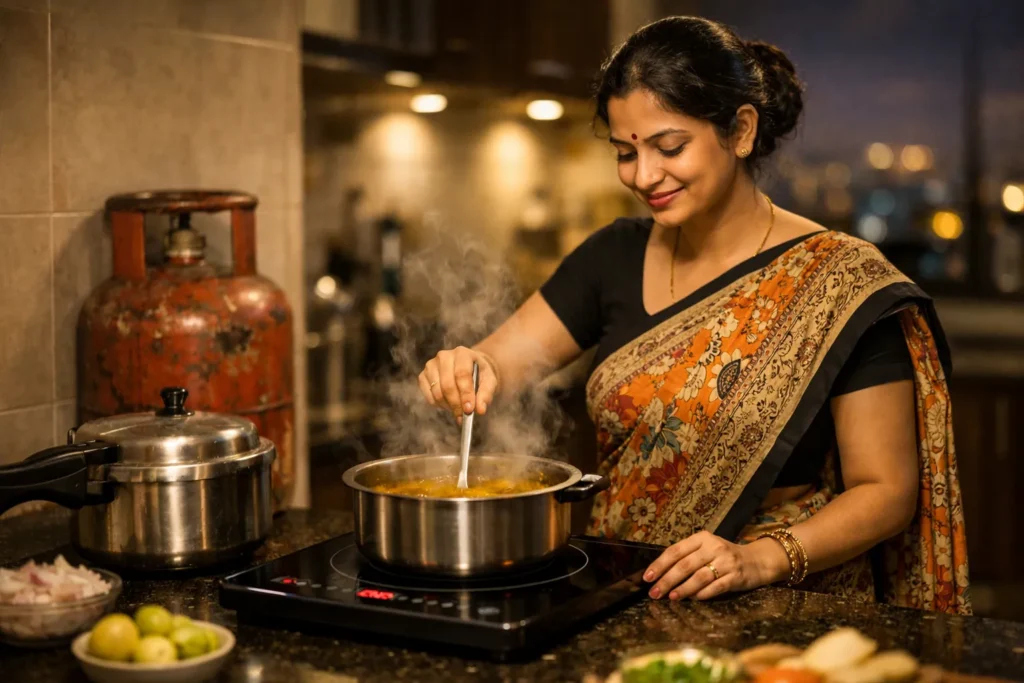
Meenakshi Raghavan had cooked on gas her entire life. More than forty years of turning a knob, the soft whomp of a flame catching, the visual reassurance of blue fire licking the base of her pressure cooker. When her apartment complex in Jayanagar ran out of LPG cylinders for the third time in February, she did what she swore she’d never do. She bought an induction cooktop.
“My daughter set it up in twenty minutes,” she says, laughing slightly at herself. “I stood there feeling like a fool, pressing buttons to boil water. But it boiled faster than my gas ever did.”
Meenakshi is far from alone. Across Bengaluru, a quiet but significant behavioural shift is underway—driven not by government campaigns, not by environmental slogans on social media, but by a city that simply ran out of cylinders. As the LPG crisis deepens, households are making a switch to induction cooking faster than any policy push ever managed.
A Crisis That Carrier Messages Didn’t
LPG supply disruptions have been escalating in Karnataka since late 2025, with Bengaluru’s population and housing density outpacing last‑mile distribution networks. Reports show that in early 2026 some residential areas saw wait times stretching to multiple days, and several commercial kitchens were forced to shut down temporarily when bulk‑cylinder supply was halted statewide.
The result has been a noticeable surge in induction‑cooktop sales. Industry data indicate that India’s induction‑stove market grew robustly in 2025, and early‑2026 figures show further acceleration, with Bengaluru and other major metros registering especially sharp demand spikes. Retailers in key commercial hubs report that many customers now treat induction not as a backup but as a primary cooking solution.
“Earlier, induction was something people bought as a backup,” says a senior sales manager at a large appliance chain in Jayanagar (who prefers not to be named). “Now we’re seeing people ask whether they even need to renew their gas connection.”
The Electricity Question No One Read About
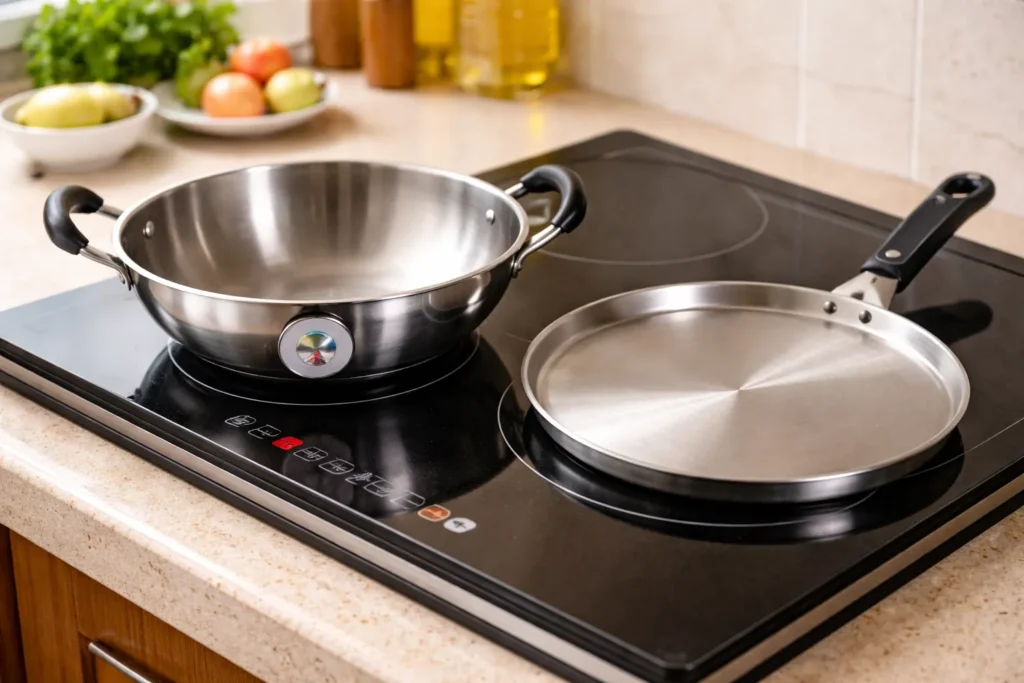
This shift is landing in apartment complexes with little formal planning, and it’s creating a secondary challenge for facility managers.
A typical single‑burner induction cooktop draws around 1,800–2,000 watts; a two‑burner unit can momentarily draw close to 3,500–4,000 watts when both elements are on full power. In older apartment blocks, where electrical load calculations were made years ago with gas kitchens in mind, this extra draw can stress circuits and lead to tripping—especially during peak cooking hours.
“We’ve had more than one tripping incident in C‑block this month,” says Arvind Shetty, facilities manager at a 240‑unit complex in Hebbal. “Nobody sent in a formal notice; they just switched to induction and plugged in.” His association is now talking with BESCOM about load‑enhancement options—a conversation most residents didn’t anticipate when they signed their maintenance contracts.
BESCOM has published guidelines for increasing sanctioned load when households or associations need more power, but there is no public record yet explicitly blaming feeder‑load rises on induction‑cooking alone. Electricians and facility managers, however, say that the influx of induction units is a visible factor they are now accounting for.
For residents considering induction, the practical advice is straightforward: check whether your kitchen socket is on at least a 15–16 amp circuit, confirm that your home wiring can handle the wattage of the model you choose, and—if you live in an older complex—ask your association before adding heavy loads.
Can You Actually Cook Indian Food on Induction?
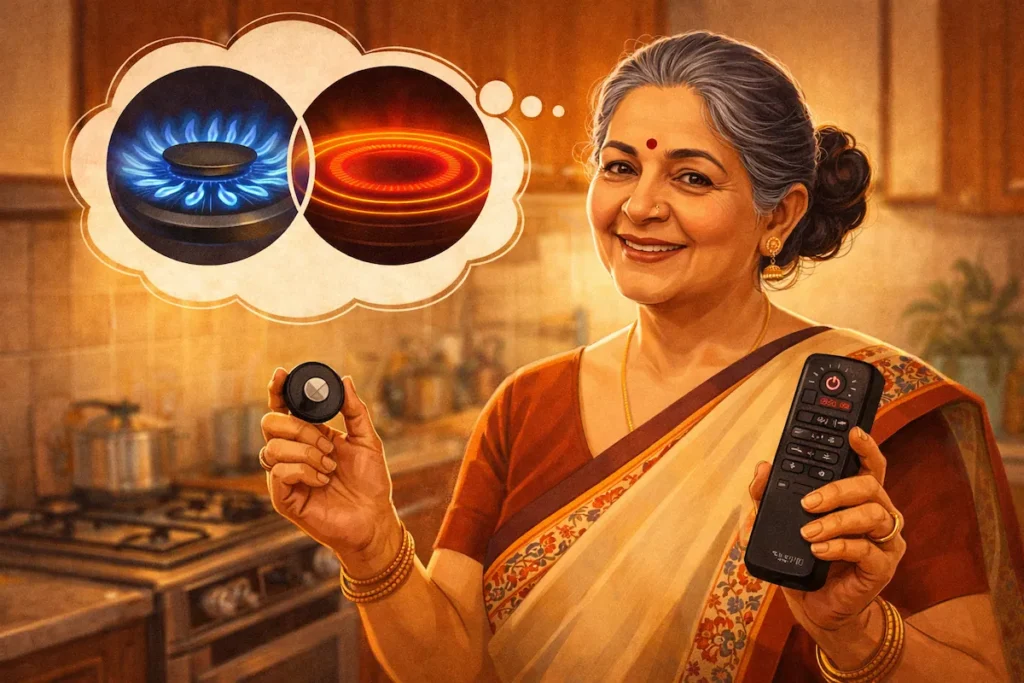
Ask this question in a Bengaluru WhatsApp family group and you will get strong opinions within minutes—some enthusiastic, some deeply skeptical.
The honest answer is: yes, but with adaptations.
Induction heats ferromagnetic cookware through a magnetic field, not a flame. That means flat‑bottomed pans and pots work well; round‑bottomed traditional kadhais do not, unless placed on a separate flat iron plate that reduces efficiency. Many Indians also miss direct‑flame techniques—charring vegetables, flipping phulkas directly on the burner, or tempering spices in a way that “feels right.” Some tasks are simply harder—or impossible—on induction alone.
“The first week I made sambar and it tasted different,” admits Priya Nair, a home cook in HSR Layout. “I couldn’t tell if it was actually different or if I was just anxious.” She eventually settled on the idea that a changed technique was partly to blame. “Once I stopped treating the induction like a gas stove pretending to be electronic, the cooking improved.”
Nutrition and public‑health experts broadly endorse the switch. Studies show that gas stoves generate indoor nitrogen dioxide (NO₂) and other combustion‑related pollutants, which can aggravate asthma and impact respiratory health, especially in poorly ventilated kitchens. Induction, which produces no combustion byproducts, significantly reduces these risks.
“The reduced indoor air pollution is genuinely important for households with young children or anyone with breathing issues,” says a public‑health consultant in Bengaluru who advises urban families on kitchen safety. “From a nutrition angle, the method of heat delivery doesn’t change the nutritional value of the food itself, but a cleaner cooking environment is a clear health win.”
Restaurants Are Adapting, Quietly
The shift isn’t confined to homes. Several mid‑sized restaurants in Bengaluru have begun using induction stations for specific tasks—especially desserts, gravies, and sauces that benefit from precise temperature control—while retaining gas for high‑heat wok cooking and tandoor‑style ovens, which induction cannot yet replicate economically.
“We installed four induction units for our mithai workstation a few weeks ago,” explains the owner of a North Indian restaurant in central Bengaluru, who asked not to be named. “Our gas consumption has dropped, and the consistency of our kheer and halwa has improved because the cook isn’t guessing the flame.” He estimates that the change will pay for the new units within a few months, though exact figures depend on usage and local tariffs.
Full‑induction restaurant kitchens remain rare, mainly because of upfront cost, power‑load constraints, and the limitations with flame‑intensive dishes. Still, the hybrid model—gas for fire, induction for precision—is gaining traction faster than many in the industry expected.
What You Can Do This Week
If you’re considering the switch—whether out of convenience, cost, or a stalled LPG refill—here is a practical checklist:
Check your cookware. Use a magnet: if it sticks firmly to the base of your pots and pans, they will work on induction. Stainless steel and cast iron usually qualify; aluminium and copper generally do not.
Start with a mid‑range model. Brands such as Philips, Havells, and Bajaj offer 1,800–2,000 W units in the roughly ₹2,500–₹5,000 range that handle everyday Indian cooking well for most households.
Budget for at least one new vessel. A flat‑bottomed induction‑compatible kadhai (around ₹800–₹1,500) will make the transition smoother than trying to adapt all your existing round‑bottomed cookware.
Talk to your apartment association. In older complexes, a quick check with your electrician about circuit capacity can prevent tripped breakers at dinner time.
Give yourself two weeks. Most cooks who struggled initially report that by the end of the second week, the new rhythm feels natural, and the speed and cleanliness begin to outweigh nostalgia for gas.
The Flame Nobody Missed
Meenakshi’s gas cylinder finally arrived after a gap of nearly three weeks—long enough for her to fully rely on the induction cooktop. She used the gas once, to char a brinjal for chutney. Then she went back to induction for everything else.
“I didn’t expect to say this,” she says. “But I think I prefer it now. It’s faster. It’s cleaner. The kitchen doesn’t get as hot.” She pauses. “Don’t tell my mother‑in‑law.”
Bengaluru didn’t plan this revolution. It didn’t campaign for it, didn’t subsidise its way into it, didn’t even explicitly debate it. A supply chain failed, and a million small choices filled the gap. That might be the most honest way a city ever changes: not by persuasion, but by necessity discovering that the alternative wasn’t so bad after all.