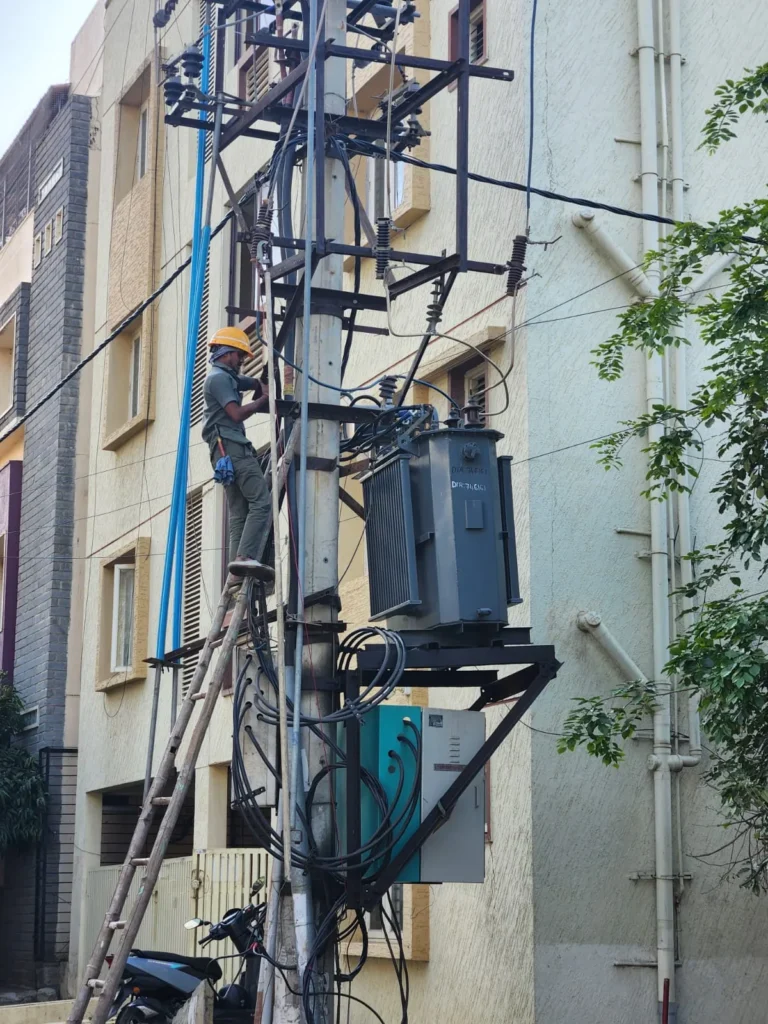
For years, unexplained appliance breakdowns and inverter failures were dismissed as “internal house wiring issues.” A four-day ordeal in HSR Layout proves why residents need real-time voltage proof—and why utility teams must look beyond a single house.
If your television power board, refrigerator compressor, or home inverter has ever burned out without warning, you may have blamed a sudden lightning strike or aging household wiring. For years in HSR Layout, many of us accepted that explanation—until a simple plug-in voltage protector revealed a silent, recurring hazard coming straight from the street transformer. You can even just get a voltage indicator, if you don’t want any protection and it’s much cheaper too.
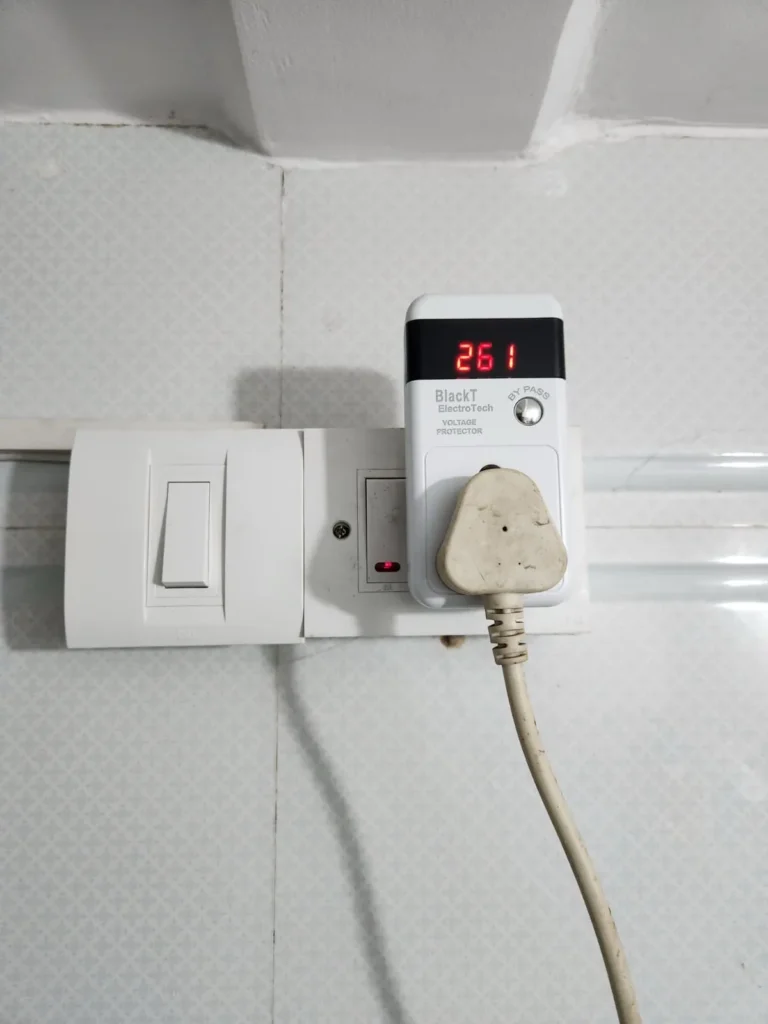
Over a four-day stretch this week, real-time voltage readings on our street consistently crossed 258V to 261V—well above India’s standard 230V domestic supply. What followed was a revealing look at how BESCOM handles voltage complaints, where the system works well, where ground-level troubleshooting falls short, and how Bengaluru residents can protect their homes.
The Four-Day Timeline: From Individual Complaint to Transformer Replacement
* Day 1 – Unprepared First Visits: After logging a complaint with the BESCOM 1912 helpline and the local Junior Engineer (JE), the BESCOM control room proved remarkably diligent, calling regularly to track the status of our ticket. However, the ground staff appeared stretched thin and arrived unprepared—showing up on the first visit without a multimeter, forcing a return trip the next day.
* Day 2 – A Temporary Fix: Once tested, linemen tightened the neutral wires on the street pole and the building’s distribution board (DB). Voltage briefly settled at 244V, but within two hours, it climbed right back to 254V. The root cause remained untouched.
* Day 3 – Convincing BESCOM to Check the Street: Ground teams are perpetually in a hurry, and the default reflex is to treat a voltage complaint as an isolated consumer wiring defect. It took persistent persuasion both over the phone and in person before a BESCOM technician finally agreed to test neighboring houses—confirming our suspicion that the high voltage was affecting the entire street, not just one building.
* Night of Day 3 – The 10:30 PM Emergency Dispatch: When voltage surged past 261V after 10:00 PM, we posted live photographic proof of the voltage display into a neighborhood WhatsApp group that includes local BESCOM officials. To their credit, they dispatched an emergency crew at 10:30 PM to step down the transformer’s voltage tapping. However, the team discovered the transformer’s tap-changing rod was missing, leaving them unable to adjust it overnight.
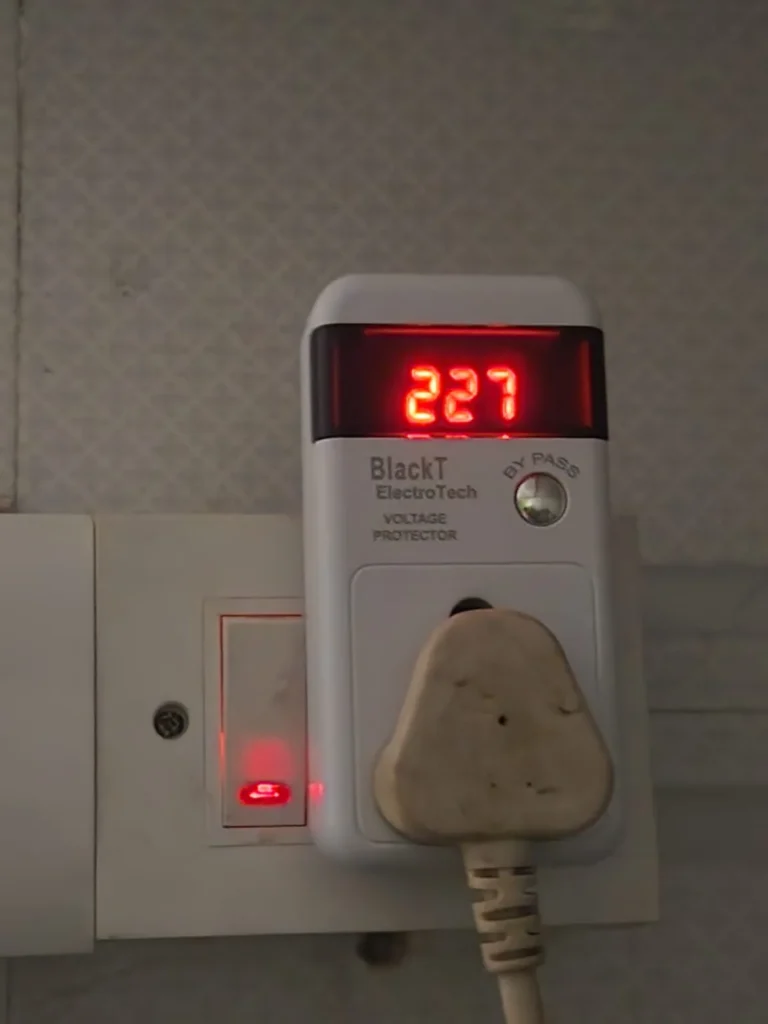
* Day 4 – Transformer Replaced: True to their word, BESCOM crews returned first thing the next morning and replaced the faulty transformer entirely. Within minutes, street voltage dropped to a healthy 227V–229V.
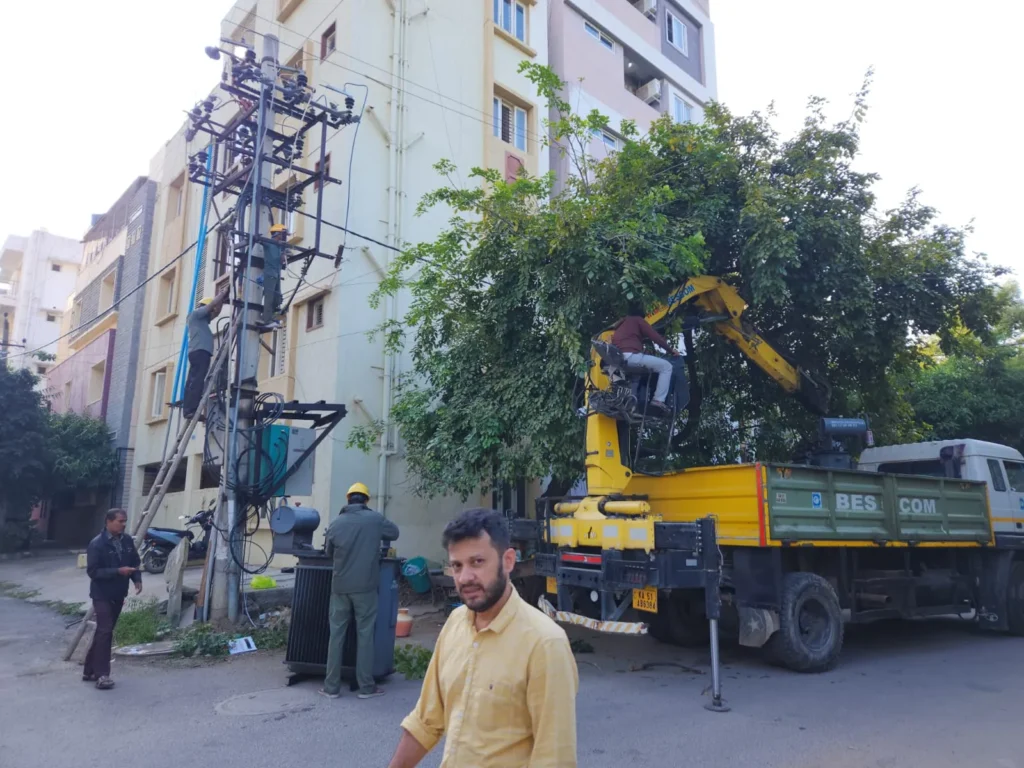
What BESCOM Needs to Change on the Ground
While the control room’s follow-up calls and the eventual transformer replacement deserve credit, this four-day struggle highlights two critical gaps in field operations:
* Test Neighboring Houses First: Every time a lineman receives a high- or low-voltage complaint, checking two or three adjacent homes should be mandatory protocol. Relying solely on how many residents complain—while blaming internal household wiring by default—delays fixes for street-wide transformer faults.
* Equip Field Crews Properly: Sending linemen to a voltage complaint without a working multimeter wastes valuable response time and forces repeat visits for an already understaffed workforce.
Five Practical Lessons for Bengaluru Residents
Until street-level diagnostic habits improve, homeowners cannot afford to fly blind. Here is how to protect your appliances and hold utility providers accountable:
* Buy a Plug-In Digital Voltage Protector (₹800–₹1,200): Over the years, high voltage silently damaged our household appliances and UPS units without us ever realizing the grid was at fault. A simple plug-in voltage protector with a live LED display acts as both an automatic circuit breaker during surges and undeniable photographic evidence when escalating complaints to BESCOM.
* Keep Your Home Inverter in “UPS Mode” (Not ECO Mode): Check the small selector switch on the back of your inverter. In ECO mode, an inverter passes raw grid voltage (even 260V) straight through to your television, computers, and Wi-Fi router. In UPS mode, the inverter detects over-voltage above ~248V and immediately cuts off mains power, shifting your sensitive electronics safely onto battery backup.
* Never Rely on Standard Spike Busters Alone: Common surge strips only clamp brief microsecond lightning spikes; they do not block sustained 255V–265V over-voltage from a faulty transformer.
* Check Voltage Before Running Heavy Appliances: If your monitor reads above 248V–250V—especially late at night when neighborhood load drops and grid voltage rises—delay running sensitive microprocessor appliances like dishwashers, front-load washing machines, and convection ovens until morning.
* Document and Escalate with Evidence: Log your complaint on the BESCOM 1912 helpline to generate a docket number, and share timestamped photos of your voltage meter in your RWA and local BESCOM escalation groups.
A ₹1,000 voltage monitor did what years of guesswork could not: it proved the problem wasn’t inside our walls, protected our electronics during midnight surges, and gave BESCOM the evidence needed to replace a failing transformer. Every household in Bengaluru should consider it essential equipment.


